Sealing industry is not just a technical requirement in industrial systems, but a critical safety factor. Whether it is refineries, chemical plants, power generation units, or any other industry, even a minor leak in a high-pressure flange connection can lead to safety compromises and environmental hazards, proving disastrous. This is where ASME B16.20 spiral wound gaskets play a vital role. ASME B16.20 is the globally recognized standard that governs the dimensions, materials, markings, and tolerances of spiral wound gaskets. Understanding this standard is essential for professionals who rely on consistent sealing performance under extreme conditions. This blog provides a detailed explanation of ASME B16.20 spiral wound gaskets, and why compliance is critical for industrial reliability.
What are spiral wound gaskets?
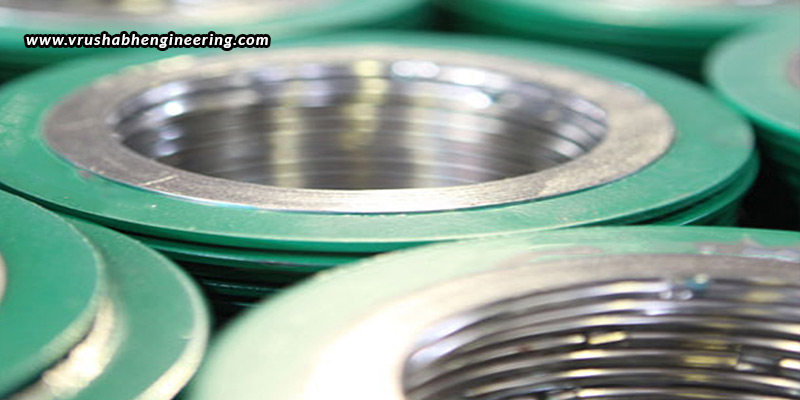
Spiral wound gaskets are semi-metallic sealing components made by winding alternating layers of metal strips and soft filler materials. The metal can comprise of stainless steel, Inconel, or Monel; while the filler material is generally graphite or PTFE. These layers are wound in a spiral formation and shaped into a ring with optional inner and outer guide rings. This unique construction allows the gasket to balance and enjoy the benefits of both – the metal’s strength and durability, and the non-metal’s flexibility and recovery. Spiral wound gaskets are capable of withstanding high pressures and temperatures, while maintaining resilience under thermal cycling and providing excellent recovery after compression. Because of these advantages, spiral wound gaskets are widely used in critical industrial applications where soft gaskets would fail.
What is ASME B16.20?
ASME B16.20 is a standard published by the American Society of Mechanical Engineers (ASME) that specifies requirements not only for spiral wound gaskets, but also for metal jacketed gaskets, and ring joint gaskets. For spiral wound gaskets specifically, ASME B16.20 defines:
- Standard dimensions for various flange ratings
- Material requirements for winding strip, filler, and centring rings
- Tolerances for thickness, width, and diameter
- Marking and identification requirements
- Pressure-temperature performance compatibility
The standard ensures that gaskets are manufactured with uniform dimensions and specifications, making them fully interchangeable and compatible with ASME B16.5 and B16.47 flanges globally. Vrushabh Engineering, a trusted ASME spiral wound gasket manufacturer Saudi Arabia, delivers precision-engineered gaskets that meet these standards, ensuring reliable performance in critical industrial applications.
Key specifications under ASME B16.20
ASME B16.20 does not just define a shape; it defines engineering precision by setting strict dimensional tolerances, material requirements, and design standards to ensure reliable sealing performance in critical applications. The key specifications include:
- Standardized dimensions
ASME B16.20 defines standardized gasket dimensions to ensure proper fit with flange types such as raised face, flat face, and ring type joint flanges. It specifies inner and outer diameters, gasket thickness, and centering ring sizes. These precise dimensions ensure correct seating, uniform load distribution, and reliable sealing performance.
- Gasket thickness
Standard gasket thicknesses include 3.2 mm (1/8 inch) and 4.5 mm (3/16 inch). Thickness plays a key role in sealing performance, compressibility, and recovery. While thicker gaskets may improve sealing in uneven surfaces, they require higher bolt load to achieve proper compression and maintain leak-free joint integrity.
- Metal strip and filler materials
ASME B16.20 allows selection of materials based on operating conditions. Metal winding strips include stainless steel, Inconel, Monel, and Hastelloy for strength and corrosion resistance. Filler materials such as flexible graphite, PTFE, and mica are chosen for temperature resistance, chemical compatibility, and reliable sealing under demanding service conditions.
- Pressure class compatibility
Spiral wound gaskets are designed to match ASME flange pressure classes such as 150, 300, 600, 900, 1500, and 2500. Each class indicates the pressure and temperature limits the gasket can safely handle. This ensures safe operation, prevents leakage, and maintains sealing integrity in high-pressure industrial applications.
Importance of compliance with ASME B16.20
ASME B16.20 compliance is a benchmark for safety, reliability, and interoperability. ASME B16.20 compliant gaskets guarantee leak-free performance, interchangeability, and safety in high-pressure systems. It also supports regulatory and inspection requirements and improves equipment lifespan.
- Leak-free performance
ASME B16.20 ensures uniform gasket design and controlled compression, providing consistent sealing across flange joints. This reduces leakage risks caused by uneven loading, poor fit, or material variations.
- Interchangeability
Gaskets made to ASME B16.20 standards fit flanges globally without modification, provided both follow ASME guidelines. This simplifies maintenance, ensures quick replacement, and reduces downtime in industrial systems.
- Safety in high-pressure systems
In industries like oil, gas, and power generation, ASME compliance ensures gaskets can withstand high pressure and temperature conditions, improving safety and preventing unexpected sealing failures.
- Regulatory and inspection requirements
ASME-certified gaskets meet industrial audit and inspection standards. Their use simplifies compliance, helps pass certifications easily, and ensures adherence to strict safety and quality regulations.
- Equipment lifespan
Proper sealing reduces flange stress, vibration, and leakage. This protects bolts and connected equipment, reducing wear and extending the overall service life of piping systems and machinery.Top of Form
Bottom of Form
Applications of ASME B16.20 spiral wound gaskets
Spiral wound gaskets are widely used across industries due to their durability and adaptability, being most widely used in the oil and gas industry, chemical processing industry, petrochemical plants, power plants, and marine and offshore applications.
- Oil & gas industry
Spiral wound gaskets are widely used in pipeline flange connections, refinery processing units, and offshore platforms to ensure reliable sealing under high pressure and temperature conditions.
- Chemical processing
In chemical industries, they are used in acid handling systems and highly corrosive environments, where strong chemical resistance and secure sealing are essential for safe operations.
- Petrochemical plants
They are applied in high-temperature reactors and pressure vessels, ensuring safe containment of fluids and gases under demanding operating conditions in petrochemical production processes.
- Power plants
These gaskets are used in steam turbines, boilers, and heat exchangers to maintain leak-free performance and withstand extreme heat and pressure in continuous power generation operations.
- Marine and offshore applications
These gaskets are used in seawater systems and fuel handling systems, providing durable sealing performance in harsh marine conditions with constant exposure to moisture and corrosion.
ASME B16.20 spiral wound gaskets represent a critical engineering solution for modern industrial sealing challenges. By defining strict specifications for dimensions, materials, and performance, the standard ensures consistency, safety, and reliability across global industrial applications. Whether used in oil refineries, power plants, or chemical processing units, these gaskets provide reliable sealing under extreme pressure and temperature conditions. For engineers and procurement teams, understanding ASME B16.20 is not just about compliance; it is about ensuring operational safety and long-term system integrity. In industries where failure is not an option, compliance with ASME standards is what separates reliable systems from the others.