From pipelines and industrial machinery to automotive equipment and chemical processing systems, gaskets help maintain reliable connections under different operating conditions. However, not all gaskets offer the same level of performance. Traditional gaskets generally serve standard sealing requirements, while precision-engineered gaskets are developed to meet specific application demands through carefully selected materials, accurate dimensions, and specialized manufacturing processes. Understanding the difference between these two types of gaskets helps businesses make informed decisions when selecting sealing solutions. This blog explores their key differences to understand why precision-engineered gaskets are increasingly preferred for demanding industrial requirements.
Traditional gaskets
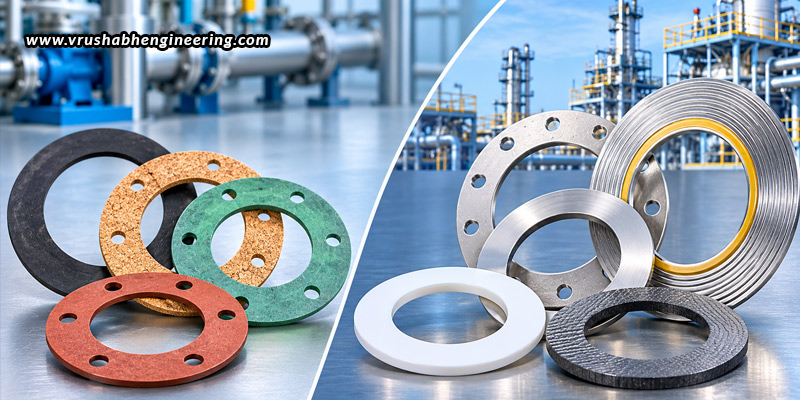
Traditional gaskets are commonly used sealing components manufactured in standard shapes, sizes, and material specifications. They are designed to fit between two surfaces and prevent the passage of liquids, gases, or other substances. These gaskets are widely available and are generally suitable for applications with relatively predictable operating conditions. Made generally from rubber, cork, fibre, and compressed non-asbestos sheets, their primary advantage is accessibility and suitability for routine sealing requirements. Standard dimensions and readily available materials make them convenient for applications that do not require specialized performance characteristics. However, when equipment operates under fluctuating temperatures, higher pressures, aggressive chemicals, or demanding mechanical conditions, standard gasket specifications may not always provide the required sealing performance.
Precision-engineered gaskets
Precision-engineered gaskets are sealing components manufactured with specific application requirements in mind. Unlike traditional readily available options, their design considers factors like operating pressure, temperature variations, fluid compatibility, flange dimensions, surface finish, and mechanical loading. These gaskets may be manufactured using materials like stainless steel, graphite, PTFE, elastomers, and specialized composite materials, depending on the intended application. Their dimensions, thickness, material composition, and construction are carefully controlled to achieve the required fit and sealing characteristics. The goal is not simply to manufacture a gasket with accurate dimensions, but to develop a sealing solution that matches the equipment’s actual operating requirements.
Traditional gaskets vs. precision-engineered gaskets: Key differences
Although both types of gaskets perform the same fundamental function, they differ in several aspects, including design, material selection, manufacturing accuracy, and application suitability.
- Design and dimensional accuracy
Traditional gaskets are generally manufactured according to standard dimensions and commonly available specifications. Precision-engineered gaskets, on the other hand, are manufactured according to specific dimensional requirements. Their inner diameter, outer diameter, thickness, and overall configuration are carefully considered to ensure compatibility with the mating surfaces. This makes them suitable for equipment requiring customized sealing arrangements and closer dimensional control.
- Material selection
Traditional gaskets are commonly available in standard rubber, fibre, cork, and other conventional materials. Their suitability depends on the temperature, pressure, and media involved in the application. Depending on the operating conditions of the application, manufacturers can use stainless steel, graphite, PTFE, and specialized elastomers or composite materials for precision-engineered gaskets. Selecting the appropriate material helps ensure compatibility with the process media and the operating environment.
- Manufacturing process
Traditional gaskets are often manufactured using conventional cutting, punching, and forming processes. These methods are suitable for producing standard gasket shapes and sizes in relatively large quantities. But, precision-engineered gaskets involve more controlled manufacturing processes, including CNC machining, laser cutting, waterjet cutting, and specialized forming techniques. These processes help achieve accurate dimensions, consistent thickness, and the required design specifications.
- Performance under operating conditions
Standard gaskets are generally suitable for applications involving moderate and predictable operating conditions. However, their performance may be limited when exposed to significant temperature fluctuations, high pressure, chemical exposure, or repeated mechanical stress. Precision-engineered gaskets, on the other hand, are designed around the specific operating conditions of the equipment. Appropriate material selection and construction help them maintain sealing performance under demanding conditions, provided the gasket is correctly specified, installed, and operated within its design limits.
How precision engineering improves sealing reliability
Traditional gaskets are undoubtedly suitable for preventing leaks and maintaining reliable seals, but they may not always accommodate unique installation requirements. This is where precision engineering helps improve reliability through several important considerations.
- Accurate dimensions: Properly controlled dimensions help ensure that the gasket fits the intended flange or equipment configuration. Incorrect dimensions can result in uneven compression, poor contact, or leakage.
- Consistent thickness: Gasket thickness influences compression and sealing behaviour. Maintaining the specified thickness helps achieve the intended contact between mating surfaces.
- Appropriate material properties: Selecting materials according to temperature, pressure, and chemical exposure helps prevent premature deterioration and material incompatibility.
- Controlled manufacturing: Consistent manufacturing processes help reduce dimensional variations and ensure that gaskets meet the required specifications across production batches.
- Application-specific design: Considering the actual operating environment allows the gasket design to address particular sealing challenges rather than relying on a general-purpose solution.
Together, these factors contribute to more dependable sealing arrangements and help reduce the likelihood of problems associated with unsuitable gasket selection. For industries requiring dependable and application-specific sealing solutions, Vrushabh Engineering offers expertise in manufacturing precision-engineered gaskets. With a focus on material suitability, dimensional accuracy, and quality manufacturing, the company caters to diverse industrial sealing requirements.
Factors to consider when choosing between the two
Selecting the right gasket requires an understanding of the equipment and the conditions under which it operates. Businesses should evaluate several factors before making a decision.
- Operating pressure and temperature: Determine the pressure and temperature ranges the gasket must withstand, including possible fluctuations during operation.
- Process media: Consider whether the gasket will come into contact with oils, fuels, chemicals, steam, water, or gases.
- Flange specifications: Check the dimensions, surface finish, flange type, and applicable standards of the mating surfaces.
- Material compatibility: Choose a material that can withstand the operating environment without excessive degradation or loss of sealing properties.
- Installation requirements: Consider the required compression, bolt loading, installation procedure, and maintenance conditions.
- Application complexity: Evaluate whether a standard gasket can meet the equipment requirements or whether a customized design is necessary.
Considering these factors helps businesses select suitable sealing components while avoiding unnecessary customization or the use of standard products in applications where they may not be appropriate.
Choosing between traditional and precision-engineered gaskets ultimately depends on the requirements of the equipment, the nature of the application, and the expectations for long-term operation. While standard options remain practical for routine sealing needs, specialized applications may require solutions developed around specific technical requirements. Businesses should therefore look beyond initial availability and consider how gasket selection affects equipment compatibility, maintenance planning, and operational continuity. A well-informed decision can help avoid unnecessary replacements, minimize unexpected interruptions, and support consistent equipment performance. Ultimately, selecting the right sealing solution is an important part of maintaining dependable industrial operations.