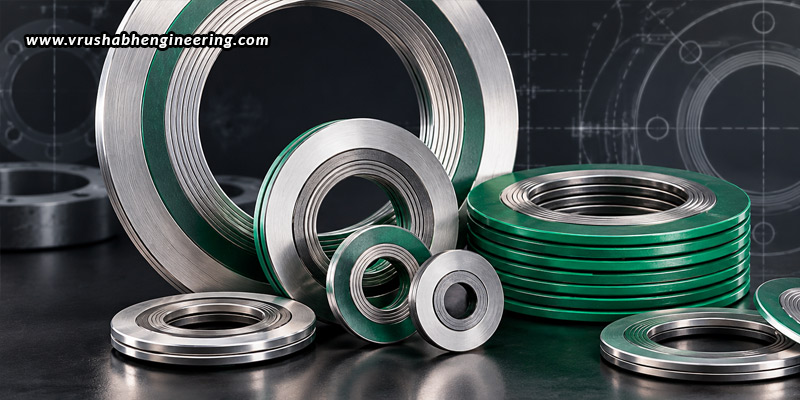
Selecting the right spiral wound gasket is essential for maintaining a reliable and leak-free flanged connection. The gasket should be matched to the flange, pressure, temperature, process medium, and operating conditions. ASME spiral wound gaskets offer mechanical strength, compressibility, and resilience for demanding services, but their construction must suit the application. Winding material, filler, dimensions, inner and outer rings, flange standard, and service conditions should all be evaluated before selection. For ASME-standard flanges, gasket selection should also follow the applicable requirements of ASME B16.20. A systematic selection process helps engineers, maintenance teams, and procurement professionals choose the right gasket for reliable performance.
1. Identify the flange standard and facing type
The first step is to identify the flange for which the gasket will be used. The gasket dimensions must correspond to the flange dimensions to ensure correct positioning and compression. The flange size, pressure class, and facing type should be established before ordering the gasket. Starting with these details helps narrow down the appropriate gasket dimensions and configuration for the specific flanged connection. Complying with the applicable flange and gasket standards also ensures proper fit and sealing performance.
2. Determine the operating pressure
The next consideration is the pressure that the gasket will experience during service. Both normal operating pressure and maximum design pressure should be considered. A gasket must have sufficient structural stability to maintain the seal under pressure without excessive deformation or blowout. The pressure class of the flange should therefore be confirmed along with the actual operating and design pressure of the system.
3. Establish the operating temperature
A gasket may be exposed to elevated temperatures, temperature fluctuations, or repeated thermal cycling, all of which can affect both the metal winding and filler material. For high-temperature applications, it is thus important to pay particular attention to the metal winding material, filler temperature capability, thermal expansion, thermal cycling and gasket recovery. Temperature should be evaluated together with pressure for the best results.
4. Identify the process medium
Different process media can have significantly different effects on gasket materials. Hydrocarbons, steam, chemicals, water, gases, and corrosive substances may require different material combinations. The process medium should be evaluated for chemical compatibility, corrosiveness, operating temperature, operating pressure, and flow conditions.
5. Select the appropriate winding material
The metal winding provides much of the gasket’s mechanical strength and resilience. Its material should thus be carefully selected according to the operating environment, considering factors like the temperature, pressure, chemical exposure, chances of corrosion, and process medium. The winding material should be capable of maintaining its integrity under the expected service conditions without losing its sealing properties.
6. Choose the correct filler material
The filler contributes significantly to the gasket’s sealing capability, and should be selected according to the temperature, pressure, process medium, chemicals involved, and required sealing performance. However, the winding and filler materials must work together as a complete gasket construction. Selecting one without considering the other can lead to an unsuitable gasket specification.
7. Decide on the ring configuration
Depending on the application, a spiral wound gasket may have an outer ring, an inner ring, or both. The outer ring helps centre the gasket within the flange assembly and controls compression. The inner ring supports the gasket’s inside diameter and protects the winding from pressure, turbulence, and process conditions. For demanding applications, using both rings can provide greater stability, protection, and reliable sealing performance.
8. Confirm gasket dimensions
Once the application conditions and materials have been established, the gasket dimensions need to be confirmed. Important dimensions include the inside diameter, outside diameter, ring dimensions, gasket thickness, flange size, and pressure class. Incorrect dimensions can result in poor positioning, improper compression, interference with the flange bore, or inadequate sealing contact.
9. Match the gasket to the pressure class
The gasket should be selected for the applicable flange pressure class. ASME flange systems use standardized pressure classes, and the gasket dimensions and configuration must correspond to the relevant flange arrangement. Correct pressure-class matching supports proper gasket seating and ensures that the gasket is appropriately specified for the flange assembly.
10. Consider the flange condition
The flange faces should be examined for surface damage, surface irregularities, scratches, pitting, warping, misalignment, and corrosion. A spiral wound gasket can accommodate minor surface imperfections, but it cannot compensate indefinitely for severely damaged or misaligned flange faces. The sealing system should therefore be evaluated as a combination of gasket, flange, bolts, and installation procedure.
Working with a manufacturer that understands industrial requirements
Selecting the right spiral wound gasket is not simply a matter of choosing a size from a catalogue. The manufacturer should understand the relationship between gasket construction, flange specifications, materials, and operating conditions. A suitable manufacturer should provide clear information about gasket construction, material options, dimensions, ring configurations, applicable standards, marking and identification, and manufacturing requirements. For critical applications, this technical information should be reviewed before the gasket is approved for use. This is particularly important for applications involving unusual temperatures, high pressures, corrosive media, large flange sizes, or specialized material requirements, where proper gasket selection can directly affect sealing reliability and service performance. Vrushabh Engineering is an ASME spiral wound gasket manufacturer Saudi Arabia, offering spiral wound gaskets for demanding industrial sealing applications. Its gasket solutions are manufactured with attention to construction, material selection, dimensions, and ring configurations, supporting reliable sealing across various flanged connection requirements.
Selecting the right ASME spiral wound gasket is essential for achieving reliable and consistent sealing performance. The gasket should be appropriately suited to the application and selected with consideration of the overall flanged connection. Following a systematic selection process can help reduce the risk of leakage, premature gasket failure, and unnecessary maintenance. It also supports better reliability and performance of the flange joint during operation. Working with a technically capable manufacturer can further help ensure that the selected gasket meets the required application needs and provides dependable sealing performance under demanding industrial service conditions.