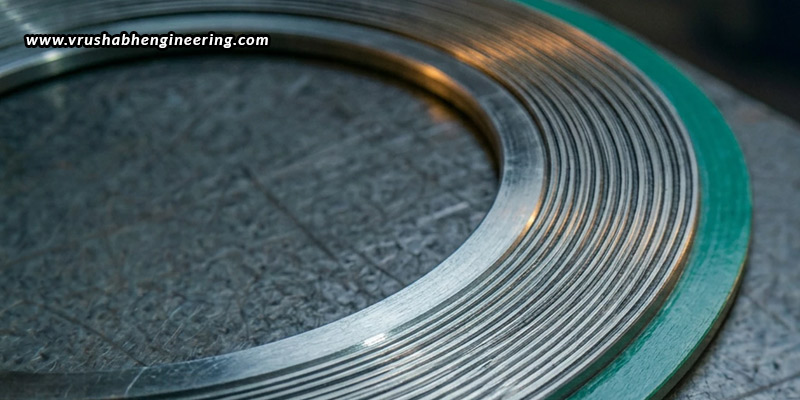
Neither is only the design important, nor only the materials, in the case of a spiral wound gasket to be able to bring about reliable sealing. Spiral wound gaskets are designed around a combination of different materials and structural components that work together to achieve this balance. Metal windings provide strength and resilience, while filler materials provide the flexibility and conformability needed to create an effective seal. Inner and outer rings can further support the gasket by improving stability, positioning, compression control, and resistance to operating stresses. Rather than functioning independently, these elements form an integrated sealing system. Understanding how they work together helps explain why spiral wound gaskets are widely used in demanding industrial applications.
Why metal and filler materials work together
Metal and filler materials have different properties, but these differences are what make their combination effective. Metal on its own can provide excellent strength and resistance to pressure, but it may not be sufficiently conformable to seal minor surface imperfections. A soft filler can provide excellent conformity, but it may not have the mechanical strength required for demanding industrial applications. The metal winding supports the gasket mechanically, while the filler occupies small surface irregularities and provides the primary sealing function. When compressed between flange faces, both materials respond to the applied load and work together to maintain sealing contact. This combination gives spiral wound gaskets a useful balance of strength, flexibility, compressibility, resilience, pressure resistance, and temperature resistance.
How the filler and metal winding share the load
When the flange bolts are tightened, the gasket is compressed between the flange surfaces. The filler material deforms and fills surface imperfections, while the metal winding provides support and controls excessive deformation. This creates a balanced response to the applied load. The filler contributes to sealing conformity, while the metal winding contributes to resilience and structural stability. As operating conditions change, the metal winding can also help the gasket recover from changes in compression. This supports continued contact between the gasket and flange surfaces. The interaction between these materials is therefore central to maintaining sealing integrity over time.
The importance of inner and outer rings
The inner ring is positioned at the inside diameter of the gasket and provides reinforcement around the area exposed to the process fluid. It improves structural stability, and reduces the possibility of inward buckling, providing additional support under pressure too. It also helps maintain the integrity of the gasket’s inner portion during installation and operation.
The outer ring is positioned around the outside diameter of the gasket, with its main role being associated with installation, positioning, and compression control. It centres the gasket within the flange, maintaining correct positioning during installation. It prevents excessive compression, and provides additional structural support, thus helping to achieve installation accuracy.
How rings complement metal and filler materials
Inner and outer rings should not be considered separate additions that simply surround the gasket. They complement the metal winding and filler materials by helping control how the gasket behaves during installation and operation. The metal winding provides strength and resilience, while the filler material provides conformity and sealing capability. The inner and outer rings provide additional structural support and control. This way, the winding and filler layers perform the primary sealing function, while the rings help maintain the gasket’s geometry; together, creating a more controlled sealing system. This integrated construction allows the gasket to respond more predictably to compression and changing operating conditions.
Compression control and changing operating conditions
Proper compression is essential for spiral wound gasket performance. Too little compression may prevent the filler from adequately conforming to the flange surfaces, leaving potential leakage paths. Excessive compression, on the other hand, may damage the filler or alter the gasket’s ability to recover from changing loads. Outer rings can help control the amount of compression applied during installation by providing a physical boundary and reducing the risk of excessive gasket compression.
Temperature changes, which is a constant in industrial systems, can cause flanges and connected components to expand and contract. Pressure fluctuations can change the forces acting on the joint. Vibration can introduce repeated mechanical movement. The filler material can adapt to surface variations, while the metal winding provides resilience. Inner and outer rings add structural stability and help maintain the gasket’s position and geometry. This combination supports continued sealing performance even when the operating environment changes.
Choosing the right spiral wound gasket construction
There is no single material combination or construction suitable for every application. The appropriate gasket configuration depends on factors like temperature, pressure, process media, flange design, operating cycles, mechanical conditions, and required service life. A standard configuration may be suitable for some applications, while more demanding conditions may require specific metal, filler, and ring combinations. Selecting these components carefully helps the gasket maintain the required compression, resist operating stresses, and remain compatible with the process environment. The relationship between the winding materials, filler, and supporting rings should therefore be considered as a complete sealing system rather than as separate components.
Quality engineering and precision manufacturing
Material selection and construction are only effective when supported by reliable manufacturing practices. As a trusted spiral wound gasket manufacturer in UAE, Vrushabh Engineering focuses on combining suitable materials with precision manufacturing to produce reliable sealing solutions for demanding industrial applications. From metal winding and filler selection to dimensional control and ring construction, attention to manufacturing consistency helps ensure that each gasket delivers dependable compression, structural stability, and sealing performance. By maintaining strict quality standards across the manufacturing process, Vrushabh Engineering supports industries looking for spiral wound metallic gaskets that can perform reliably under challenging operating conditions.
The effectiveness of a spiral wound gasket comes from the way its individual components work together. While the metal, filler materials, and inner and outer rings are individual components, they are not independent features. Their interaction determines how the gasket responds during installation and throughout its service life. Proper material selection, accurate construction, and controlled manufacturing are therefore essential for achieving consistent sealing performance. When the metal, filler, and supporting rings are appropriately selected and manufactured to precise specifications, spiral wound gaskets can provide reliable protection against leakage while accommodating pressure variations, thermal cycling, and mechanical stresses. This integrated approach to gasket design is what makes spiral wound gaskets a dependable choice for a wide range of critical industrial sealing applications.