In demanding industrial environments, the quality of a ring joint gasket is determined throughout its manufacturing process, from raw material selection to machining, dimensional control, surface finishing, and final inspection. Ring joint gaskets serve critical applications in oil and gas, refineries, petrochemical plants, power generation, and other industries where pressure, temperature, and corrosive media challenge sealing components. Their performance depends on more than appearance. Material compatibility, precise dimensions, controlled manufacturing, surface condition, and traceability all contribute to reliable sealing. Understanding these stages highlights why rigorous quality control is essential for manufacturing ring joint gaskets capable of performing consistently in demanding industrial applications.
Why quality begins with the raw material
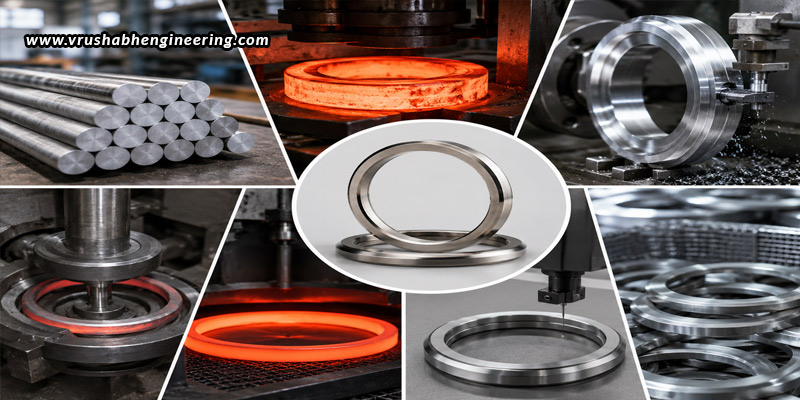
The manufacturing journey of a ring joint gasket begins with the selection of appropriate raw material. The gasket material must be suitable for the pressure, temperature, chemical environment, and flange materials involved in the intended application. Different service conditions may require different metallic materials, each material offering specific characteristics related to hardness, strength, corrosion resistance, temperature resistance, and deformation behaviour. Material selection is particularly important because ring joint gaskets depend on controlled deformation to establish the required metal-to-metal seal. The material must be capable of deforming appropriately against the flange groove without compromising the integrity of the gasket or damaging the mating flange. Using the correct material grade is therefore the first foundation of gasket quality. However, this is not enough. Material verification is also important to establish that the raw material supplied for production is consistent with the required grade. The chemical and mechanical properties of the material must correspond with the specified requirements. Material verification helps establish that the raw material supplied for production is consistent with the required grade.
Precision forming and manufacturing
Once the appropriate raw material has been verified, manufacturing begins by processing it into the required ring joint gasket configuration through suitable forming and machining processes. At this stage, precision becomes critical because the gasket’s dimensions and profile must correspond closely with the intended flange groove. Consistent geometry ensures that the gasket establishes the required contact when the flange is assembled and that load is transferred effectively between the gasket and flange. Precision machining is particularly important because even small dimensional deviations can affect gasket seating and prevent uniform contact during bolt tightening. The profile, dimensions, and sealing surfaces must therefore be manufactured accurately according to the relevant requirements. Maintaining tight dimensional control helps ensure consistency across finished gaskets and supports predictable sealing performance from one component to another. This level of manufacturing accuracy becomes especially important in high-pressure applications, where demanding mechanical loads leave little tolerance for dimensional inconsistencies that could compromise sealing integrity.
Surface finish, dimensional accuracy and profile control
The surface condition, dimensions, and profile of a ring joint gasket are closely connected to its sealing performance. Ring joint sealing depends on intimate metallic contact between the gasket and precisely machined flange groove, making surface quality particularly important. Scratches, dents, excessive roughness, machining marks, or other imperfections can interfere with contact and potentially create leakage paths. Alongside surface finish, critical dimensions such as internal diameter, external diameter, height, width, and profile characteristics must remain within specified tolerances. Even a small dimensional deviation can prevent the gasket from seating correctly within the flange groove, regardless of its material quality. Profile accuracy is equally important because oval, octagonal, RX, and BX configurations have different geometries and contact characteristics. Maintaining the correct profile ensures that load is transferred as intended during flange assembly. Consistent dimensional and profile inspection also helps identify manufacturing variations early, allowing corrective action before non-conforming gaskets reach customers or installation sites. Together, surface finish, dimensional accuracy, and profile consistency establish the foundation for predictable ring joint gasket sealing performance.
Surface inspection and defect identification
Following machining and finishing, a ring joint gasket should undergo careful inspection to identify defects that could affect its sealing integrity. Visual examination can reveal cracks, dents, scratches, corrosion, machining marks, or other irregularities that may not have been identified during earlier manufacturing stages. Particular attention should be given to the sealing surfaces because these areas establish direct contact with the flange groove. A defect that appears minor during inspection can become significant once the gasket is compressed under high flange loads. Surface damage may prevent uniform contact, concentrate stresses, or create potential pathways for fluid leakage. Inspection therefore provides an important opportunity to identify and remove non-conforming components before they are dispatched or installed. Depending on the applicable specifications and quality requirements, additional inspection methods may also be used to verify the gasket’s condition and conformity. This systematic approach helps manufacturers maintain consistency across finished products while reducing the likelihood of leakage, premature gasket failure, and performance problems in demanding industrial applications.
Packaging and storage
Packaging and storage can also influence the condition and performance of the finished component before it reaches the installation site. Precisely machined gaskets need protection from corrosion, contamination, impact, moisture, and unnecessary handling. A gasket can develop scratches, dents, or surface deterioration if it is dropped, handled carelessly, or stored in unsuitable environmental conditions. Such damage can affect the sealing surfaces and potentially compromise the gasket’s ability to establish consistent contact with the flange groove. Appropriate packaging helps protect the gasket from physical damage and environmental exposure while preserving its dimensional integrity and surface condition. Proper identification during storage is also important to prevent different sizes, materials, or profiles from being mixed. These considerations become particularly relevant when gaskets are manufactured well before installation or transported over long distances. Maintaining suitable packaging and storage conditions therefore helps preserve the quality achieved during manufacturing and inspection until the gasket is ready for use.
Quality
Ring joint gasket quality cannot be established through final inspection alone because reliable performance depends on controls implemented throughout the manufacturing process. If an incorrect material is selected at the beginning, a final dimensional inspection cannot correct the underlying issue. Similarly, machining inconsistencies may already affect the gasket’s geometry even if the finished component appears acceptable during a basic visual check. Quality therefore needs to be maintained from raw material selection through manufacturing, machining, inspection, packaging, and storage. Material verification establishes the foundation, while controlled production processes help maintain consistency in geometry and surface condition. Dimensional and profile inspections then confirm conformity with specified requirements, while traceability provides confidence in the material and manufacturing history. Proper packaging and storage help preserve these qualities until installation. Treating quality as a continuous process rather than a final checkpoint allows manufacturers to identify potential problems earlier and maintain greater consistency across finished gaskets. This comprehensive approach ultimately supports predictable sealing performance in demanding industrial applications.
Choosing a manufacturer that understands ring joint gasket quality
For industries purchasing ring joint gaskets, understanding the manufacturing process can also help when evaluating suppliers. A reliable manufacturer should be able to demonstrate control over the factors that influence gasket performance rather than focusing only on the finished product. Material traceability, dimensional accuracy, controlled machining, and inspection procedures are all indicators of a structured quality approach. These factors become particularly important when gaskets are intended for high-pressure or high-temperature applications where sealing failure can have serious consequences. Vrushabh Engineering can be considered when sourcing ring joint gaskets for demanding industrial applications where precision and manufacturing consistency are important. Its focus on ring joint gasket production, material quality, dimensional control, and inspection can help connect the manufacturing process with the performance requirements expected from critical sealing components.
The quality of a ring joint gasket is established throughout its journey from raw material to finished product. Material selection, controlled manufacturing, precision machining, dimensional inspection, surface examination, traceability, and proper packaging all contribute to sealing performance. In high-pressure and high-temperature applications, these processes directly influence gasket reliability and operational safety. A high-quality gasket is therefore more than a precisely machined component; it reflects consistent control of material properties, geometry, surface condition, and manufacturing standards. Understanding these quality factors enables industries to make informed decisions when selecting ring joint gaskets and manufacturers, ultimately supporting dependable sealing performance and long-term reliability in demanding industrial environments.