Spiral wound gaskets are commonly used in industrial piping systems, pressure vessels, heat exchangers, and other equipment that requires dependable sealing. Reliable sealing, however, depends on more than the gasket’s design and material quality. Its pre-installation condition, dimensional accuracy, and compatibility with the flange connection are also important. Ignoring small defects or omitting essential checks can cause leakage, uneven compression, and premature gasket failure. A structured inspection helps reveal potential problems before installation and confirms that the gasket is appropriate for its intended application and ready to deliver the necessary sealing performance.
Key areas to check during spiral wound gasket inspection
A thorough inspection involves checking the gasket’s physical condition, individual components, dimensions, and material details to confirm it meets the required specifications before installation.
- Inspecting the gasket for physical damage
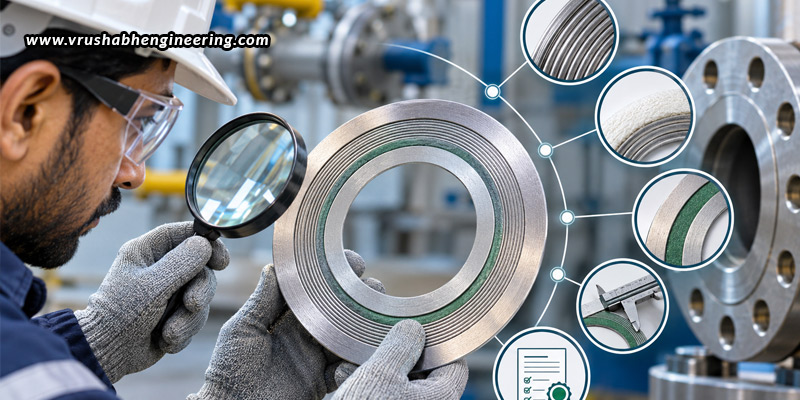
Begin by checking the spiral wound gasket’s overall physical condition. Look for visible defects such as dents, bends, scratches, distorted winding sections, or damaged edges. These flaws can prevent the gasket from sitting evenly between the flange surfaces. The metal winding should be consistent, with no loose or separated sections. Inspect the filler material for cracks, missing areas, and signs of deterioration. Assess any visible damage before approving the gasket for installation. A damaged gasket can compress unevenly, disrupting the sealing contact needed for reliable operation.
- Inspecting the metal winding
The metal winding provides the structural framework of a spiral wound gasket and helps determine its strength and recovery. During inspection, check that the winding is uniform and continuous, with no visible deformation. Uneven sections, loose metal strips, or areas of separation may indicate damage or manufacturing defects. Check also for flattening or distortion caused by improper handling, as these changes can affect gasket thickness and compression during installation. A thorough visual inspection can identify such issues before the gasket is placed between the flanges. Do not install a gasket with significant winding damage without first obtaining an appropriate evaluation.
- Examining the filler material
The filler helps a spiral wound gasket form a seal by conforming to minor irregularities in the flange surfaces. Check its condition before installation. Depending on the material, look for cracks, missing portions, contamination, or signs of deterioration. Confirm that the filler remains correctly positioned within the metal winding. Visible gaps or displaced sections can prevent uniform sealing contact. Also verify that the filler matches the specified gasket configuration. Because fillers vary in their chemical and temperature resistance, a gasket may appear acceptable but still be unsuitable if its material does not meet the requirements of the application.
- Checking the inner and outer ring condition
Depending on its design, a spiral wound gasket may have inner and outer rings that provide extra support and help keep the gasket correctly positioned during installation. Inspect these components for bends, dents, corrosion, and any other visible damage. The outer ring centres the gasket and supports it during assembly. The inner ring helps prevent the winding from deforming inward and adds stability. Damage or distortion to either ring can affect how the gasket fits within the flange connection. Check that both rings are securely attached and aligned with the winding. Inspecting their condition before installation helps confirm that the full gasket assembly is ready for service.
- Confirming the gasket dimensions and specifications
Accurate dimensions are essential when preparing a spiral wound gasket for installation. Compare the gasket’s inner diameter, outer diameter, thickness, and ring dimensions with the relevant drawings, specifications, or purchase requirements. A gasket with incorrect dimensions may not fit the intended flange arrangement properly. It could obstruct the internal flow area, sit incorrectly within the bolt circle, or fail to provide sufficient sealing coverage. Where specified, also verify the pressure class and applicable gasket standard. Checking these details before installation helps prevent compatibility issues and confirms that the gasket meets the equipment requirements.
- Verifying material identification and documentation
Before installation, verify the gasket’s identification details against the relevant technical documentation. Depending on project requirements, this information may include material specifications, dimensions, pressure class, applicable standards, and manufacturer details. Material identification is especially important when the application involves particular process media or demanding temperature conditions. Confirming the winding and filler materials helps ensure the gasket conforms to the approved specification. If material certificates or inspection records are required, review them before installation. Maintaining complete documentation supports traceability and helps prevent incorrect gasket configurations from being used in critical equipment.
Preparing the gasket for a reliable installation
After inspection, store the gasket properly until the flange assembly is ready. Protect it from dust, moisture, impact, and unnecessary handling. Prepare the installation area to allow the gasket to be positioned without obstruction or risk of damage. Before assembly, verify that the flange faces are clean, the gasket dimensions are correct, and all applicable specifications have been checked. Ensure that the gasket remains in its original shape and that no contaminants come into contact with its sealing surfaces. Any damage or contamination identified at this stage should be addressed before proceeding. Follow the recommended installation procedure, including the proper bolt-tightening sequence and torque requirements. Never force the gasket into place or alter it to make up for an incorrect fit. These final checks help ensure that the inspection leads to a correctly assembled flange connection.
Choosing quality gaskets for dependable sealing performance
A careful pre-installation inspection is essential, but gasket quality also affects the reliability of the finished seal. Consistent winding, suitable filler materials, precise dimensions, and properly constructed rings help ensure the gasket meets application requirements. Manufacturers must maintain effective material controls and quality checks throughout production. Vrushabh Engineering, recognized as the best spiral gasket manufacturer in India, focuses on material selection, dimensional precision, and consistent manufacturing to deliver spiral wound gaskets that support dependable sealing in demanding industrial applications. Its manufacturing approach emphasizes the importance of maintaining product consistency and meeting application-specific requirements. This helps industries source sealing solutions designed to provide reliable performance across different operating conditions.
Inspecting and preparing spiral wound gaskets before installation is essential for dependable sealing performance. Checking the winding, filler, supporting rings, dimensions, material specifications, and overall condition can reveal potential problems before the gasket is fitted. Inspecting flange faces, confirming compatibility, and following appropriate storage and handling practices further reduce installation-related risks. A consistent pre-installation inspection process helps prevent avoidable leakage, lowers the chance of premature gasket replacement, and supports reliable operation. Thoroughly completing these checks helps ensure spiral wound gaskets are ready for installation and suitable for the application’s demands.